
Why I joined al-Fatah?
To fight imperialism is no crime!
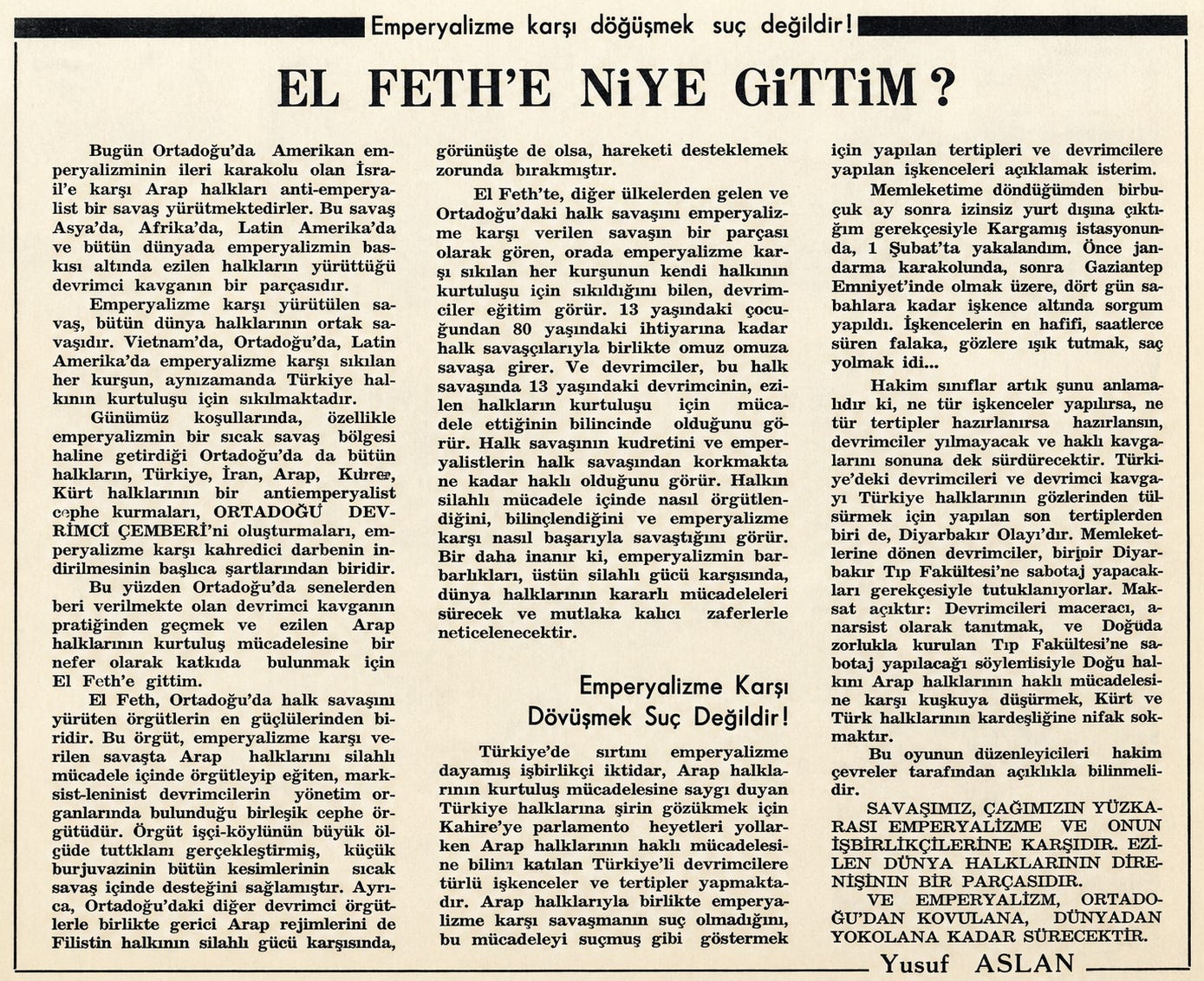
Today the Arab peoples are waging an anti-imperialist war in the Middle East against Israel, the forward outpost of American imperialism. This war is part of the revolutionary struggle that the peoples crushed under imperialism are waging in Asia, in Africa, in Latin America, and across the world.
The war against imperialism is the common war of all the peoples of the world. Every bullet fired against imperialism in Vietnam, in the Middle East, and in Latin America is fired at the same time for the liberation of the Turkish people.
Under present conditions, and particularly in the Middle East, which imperialism has turned into a zone of hot war, one of the foremost conditions for striking imperialism a crushing blow is that all the peoples of the region, the Turkish, Iranian, Arab, Cypriot, and Kurdish peoples, form an anti-imperialist front and constitute a Middle East Revolutionary Circle.1
It was for this that I joined the ranks of Fatah, to go through the practice of the revolutionary struggle that has been waged in the Middle East for years and to take part as a foot soldier in the liberation struggle of the oppressed Arab peoples.
Fatah is one of the most powerful organizations carrying on people’s war in the Middle East. It is a united front organization in whose governing organs Marxist-Leninist revolutionaries sit and which organizes and trains the Arab peoples in armed struggle against imperialism. It has gone a long way toward realizing the worker-peasant alliance and has secured the support of every section of the petty bourgeoisie within the hot war. Along with the other revolutionary organizations of the Middle East, it has also compelled the reactionary Arab regimes, confronted with the armed power of the Palestinian people, to lend the movement their support, if only in appearance.
At Fatah, revolutionaries come from other countries for training. They see the people’s war in the Middle East as part of the war against imperialism, and they know that every bullet fired there against imperialism is fired for the liberation of their own peoples. They enter combat shoulder to shoulder with the people’s fighters, from the thirteen-year-old child to the eighty-year-old elder. They see that in this people’s war, the thirteen-year-old revolutionary is conscious of fighting for the liberation of the oppressed peoples. They see the power of the people’s war and how right the imperialists are to fear it. They see how the people organize themselves through armed struggle, how they come to consciousness, and how they wage successful war against imperialism. They are convinced once more that against the barbarities and the superior armed force of imperialism, the determined struggles of the peoples of the world will go on and will end without fail in lasting victories.
To fight imperialism is no crime!
In Turkey, the collaborationist regime that leans on imperialism sends parliamentary delegations to Cairo to ingratiate itself with the peoples of Turkey, who respect the Arab peoples’ liberation struggle. At the same time it visits every kind of torture and frame-up on the Turkish revolutionaries who actually join that struggle. I want to set out the frame-ups being staged to make it look as if fighting alongside the Arab peoples against imperialism were a crime and the tortures inflicted on the revolutionaries.
A month and a half after my return home, I was seized at Karkamış station on the first of February, on the pretext of having left the country without permission. For four days, first at the gendarme post and then at the Gaziantep Security Directorate, I was interrogated under torture until the early hours of the day. Among the milder forms of torture were hours of falaka [foot whipping], lights shone into the eyes, and hair pulling.
The ruling classes need to see by now that, whatever tortures they inflict and whatever frame-ups they prepare, the revolutionaries will not yield and will carry their just struggle through to the end. One of the latest frame-ups, aimed at discrediting the revolutionaries in Turkey and the revolutionary struggle itself in the eyes of the peoples of Turkey, is the Diyarbakır Affair. Revolutionaries returning home are being arrested one by one on the pretext that they intended to sabotage the Diyarbakır Medical Faculty. The aim is plain. They want to brand the revolutionaries as adventurists and anarchists. With the rumor of sabotage against a medical faculty established in the East at such cost, they want to turn the people of the East against the just struggle of the Arab peoples and to sow discord between the Kurdish and Turkish peoples.
Let the orchestrators of this game, the ruling circles, know plainly:
Our struggle is against imperialism, the disgrace of our age, and against its collaborators. It is part of the resistance of the oppressed peoples of the world.
And it will last until imperialism is driven out of the Middle East and wiped from the earth.
Yusuf Aslan
(Ant, No. 165, 24 February 1970, p. 6)
The “Middle East Revolutionary Circle” [Ortadoğu Devrimci Çemberi] was a conceptual framework that entered Turkish political discourse in the late 1960s, articulating a regional anti-imperialist horizon that had been taking shape across the region, particularly within the Palestinian armed movement. It posited that the anti-imperialist struggle could not be confined within national boundaries but had to encompass the Turkish, Kurdish, Arab, Iranian, Greek, and Cypriot peoples as parts of a single revolutionary front against imperialism and its regional auxiliaries, with Israel cast as imperialism's forward outpost in the region. The term first appeared in Faruk Pekin’s article “Doğu Gerçeği ve Ortadoğu Devrimci Çemberi,” published in Ant on 14 October 1969. Here, Yusuf Aslan redeployed the term. The concept subsequently circulated within the People’s Liberation Army of Turkey (THKO) and the People’s Liberation Party-Front of Turkey (THKP-C), two of the major organizations of the socialist student mobilization in the late 60s and early 70s. In June 1970, Ant Yayınları institutionalized the framework by launching its namesake book series, whose inaugural volume was a Turkish translation of Nayef Hawatmeh’s Ḥarakat al-Muqāwama al-Filasṭīniyya fī Wāqiʿihā al-Rāhin and Ḥawla Azmat Ḥarakat al-Muqāwama al-Filasṭīniyya, published in Beirut in 1969.